Navigating the IIIF Landscape: A Guide to Finding Images & Manifests
February 17, 2025IIIF has revolutionized how we can access and interact with visual materials online. Yet, if you’re a researcher, educator or student, finding the right IIIF resources can be a challenge. To me, it still feels like detective work sometimes–especially when I don’t know exactly what I’m looking for in advance. Serendipitous discovery certainly hasn’t always worked for me, and over time, I found myself returning to the same go-to repositories, all while suspecting I was missing out on other valuable material.
After I launched liiive, one of the most frequent questions I got was where to find IIIF resources for specific research fields. Since my usual answer was a diplomatically worded ‘no idea’, I thought I’d turn to the IIIF community on Mastodon and Bluesky, asking people to share their favourite sources, repositories, links, and tips for finding material in the IIIF universe.
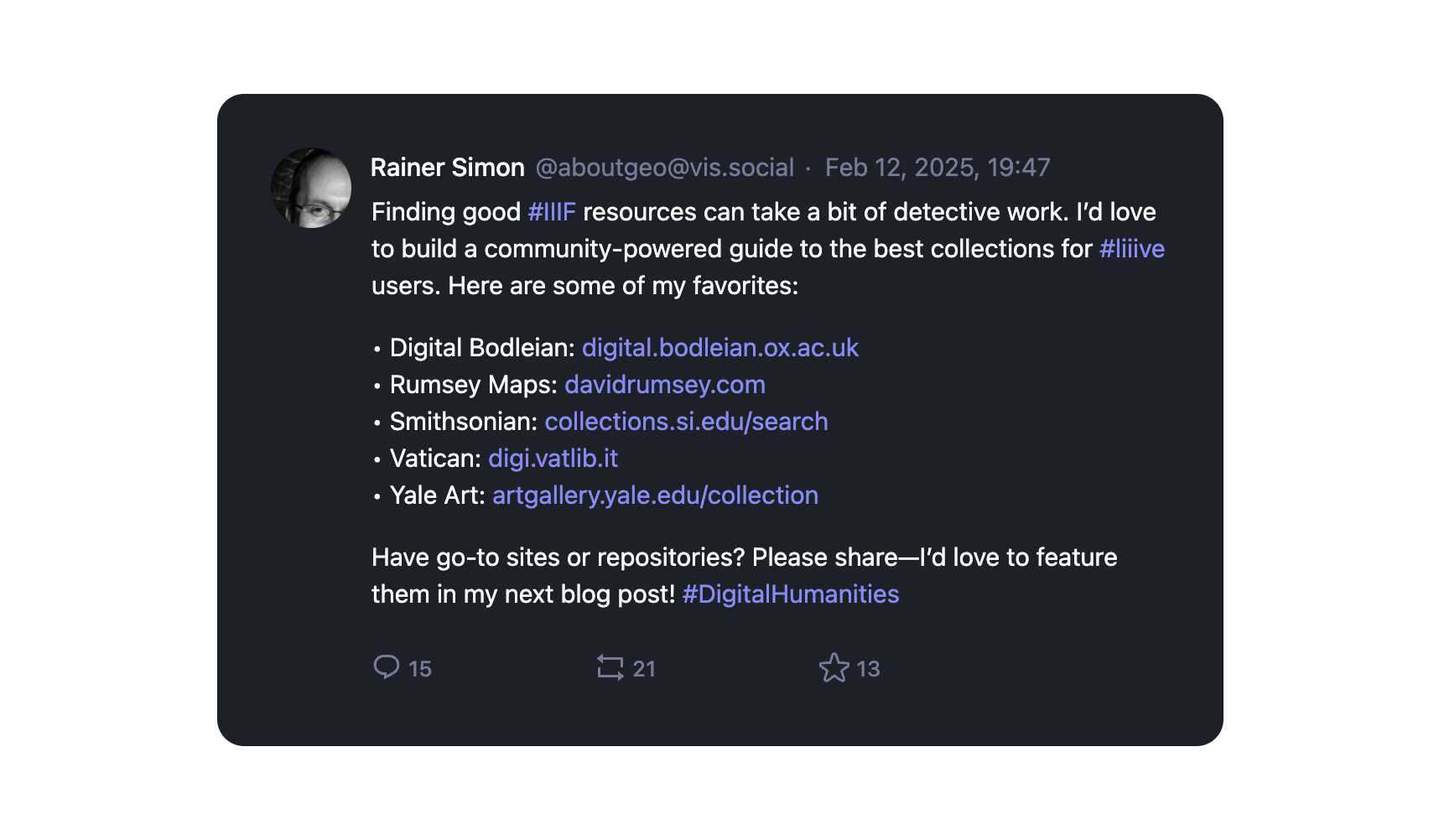
Thanks everyone–I received some fantastic responses and discovered many resources I hadn’t come across before! Below, I’ve summarized the best tips I received, along with some of my personal favourites.
Getting Started: Popular IIIF Repositories
If you’re new to IIIF, the major collections are the obvious place to start. There are many out there–iiif.io maintains a useful list–but here are some of my personal favourites that I return to again and again:
-
Digital Bodleian – A treasure trove of manuscripts, maps, and rare books from the Bodleian Libraries at the University of Oxford.
-
David Rumsey Map Collection – I’m a map buff, and this collection is the definitive source. The IIIF manifest URLs are tricky to find (I’ll cover this in an upcoming post), but as far as I know, all maps are served via IIIF–and there are more than 100,000 of them!
-
Smithsonian Collections – I love the diversity of this collection. Want to explore deep-zoomable photos of Neil Armstrong’s space suit? The Smithonian has you covered.
-
Vatican Library Digital Collections – A vast collection of manuscripts, incunabula, archival materials, and coins.
-
Yale University Art Gallery – A wonderfully rich and diverse collection of more than 190,000 items from across the world, spanning from antiquity to today.
Community Picks: Highlights & Hidden Gems
The responses I received covered a wide range of recommendations–both major repositories and lesser-known collections. Here are some standout picks:
-
Bavarian State Library Digital Collections – Over 3 million digitized manuscripts, prints, music, maps, photographs, newspapers and magazines, with 99% available via IIIF. (Via @frueheneuzeit.)
-
The Getty Museum – IIIF-enabled, with manifest links conveniently available in the “Downloads” dropdown. (Via Philip Allfrey.)
-
FranceArchives – A gateway to historical and administrative archives in France, featuring over 4.5 million digitized items. (Via Julien Benedetti and Absinthe.)
-
Bibliothèque et Archives Nationales du Québec – Uses IIIF, though I believe the manifest links are not currently being displayed directly on the website (via bethknazook).
-
Handschriftenportal – A portal of manuscripts from German collections. Also active on Mastodon and Bluesky. (Via Stephan Kurz.)
-
Portrait Collection of the Herzog August Library Wolfenbüttel – An archive of historical portraits. (Via Stephan Kurz.)
-
SACHA (Simple Access to Cultural Heritage Assets) - Provides IIIF access to historical documents at the Austrian National Library. (Via Stephan Kurz.)
-
Cuneiform 3D renderings at the HeidICON database - A specialized yet fascinating resource shared by Hubert Mara. More broadly, do check out HeidICON–the University of Heidelberg’s digital object and multimedia repository, featuring many IIIF-enabled items.
Casting a Wider Net: Aggregators and Cross-Collection Search
IIIF aggregators and search platforms allow you to explore multiple collections at once, making it easier to sift through a wider variety of resources.
-
Europeana – The well-known aggregator of European cultural heritage. While not all image materials are IIIF-enabled, there are ways to track them down. (Via Bob Coret.)
-
Museum Digital Deutschland – Featuring over 750.000 objects from nearly 1.000 German museums. (Via Alexander Winkler.)
-
Biblissima – A “virtual library of libraries” focused on the history of texts and books from Classical Antiquity through the 18th century. The portal also includes a cross-collection search engine aggregating IIIF manuscripts and rare books. (Via Régis Robineau.)
Tips, Tricks and Awesome Lists
Responses also mentioned useful resources that provide expert advice, helpful tools and curated collections of links that can help you navigate the IIIF universe more effectively.
-
Awesome IIIF list on Github – A vast curated list of IIIF resources, tools, tutorials and implementations. (Via Ujubib.)
-
Pictor – A cross-collection search tool developed by Tom Deneire, currently indexing approx. 80.000 manifests from around 50 collections. (Via Alexander Winkler and Bob Coret.)
-
Allmaps Project – A fantastic open-source initiative focused on geo-referencing digitized maps published as IIIF. Check out their curated list of IIIF maps on Github (with an invitation to contribute!). (Via Albin Larsson.)
-
Internet Archive – While there’s much more to the Archive than just IIIF, you can find manifests by following this guide on iiif.io. (Via Peter Binkley.)
-
DMMapp (Digitized Medieval Manuscripts app) – An independent project aimed at providing easy access to digitized medieval manuscripts. While many listed collections aren’t IIIF-enabled, DMMapp highlights those that are, making them easy to find. (Via Philipp Schneider.)
-
A list of Italian sites that publish IIIF collections – A useful directory of Italian libraries, archives and collections offering IIIF resources. (Via raffaele.)
-
Wikidata – Alexander Winkler has provided a sample SPARQL query to help you get started with finding Wikidata records that include IIIF Manifest links.
-
data.biblissima.fr – Biblissima runs a Wikibase instance that references dozens of IIIF-aware digital libraries. Check out their list of IIIF libraries for valuable resources, ranging from large institutions to small, local ones. Highly recommended! (Via Régis Robineau.)
Final Thoughts
IIIF has opened up incredible possibilities for researchers. The community is vibrant, friendly and growing, but finding the right resources can still take a bit of effort. Even once you’ve found a resource, tracking down the manifest URL for use in your preferred viewer (liiive, no doubt!) can require a bit of detective work (which I’ll cover that in an upcoming post).
A big thank you to everyone who shared their favorite IIIF sources and tips! If you have more to add, feel free to reach out by @-mentioning me on Mastodon or Bluesky, or by posting on the liiive community forum. I’d love to keep this post up to date with new sites, links, tips and tricks.
I hope this post has been helpful, introduced some new resources, and made it just a little easier to navigate the ever-expanding IIIF landscape.
Happy researching!

Hi I'm Rainer, a freelance software developer based in Vienna, Austria. I created liiive out of a passion for the Digital Humanities and a fascination with realtime web technologies. I believe that studying historical materials online should feel as natural and engaging as gathering around a table together. For updates and tips, follow me on Mastodon or Bluesky.